
Marine insurance explained: hull, cargo and P&I cover
A practical introduction to hull, cargo, P&I and loss-of-hire insurance, with examples of insured interests, exclusions, general average and claims.
On this page
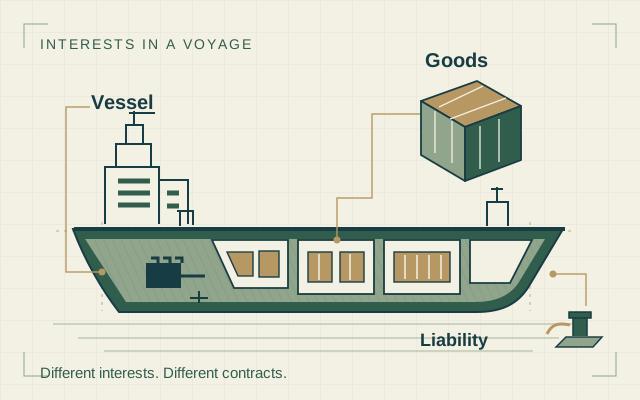
Marine insurance protects different financial interests in a voyage: the ship, the goods, specified liabilities and sometimes the vessel’s earnings. One casualty can involve several policies because each protects a different interest on its own terms.
What you will learn
- Explain the different purposes of hull, cargo, P&I and loss-of-hire insurance.
- Recognise how insured risks, exclusions, deductibles and limits affect a claim.
- Distinguish cargo damage, carrier liability, general average and salvage expenses.
What is marine insurance?
A ship can arrive safely while the goods inside one of its containers are ruined. A vessel can also suffer serious machinery damage without harming any cargo. Those losses belong to different people and call for different insurance.
Marine insurance is a family of contracts protecting agreed financial interests against maritime and transport risks. The interest might be a ship, goods in transit or a liability arising from operating a vessel. The insurer’s promise concerns the interest and risks described in the contract; the fact that a loss occurred during a voyage is only the beginning of the analysis.
Although the name suggests the sea, marine cargo insurance can include road, rail and air legs, together with agreed intermediate storage. If’s marine and cargo overview explains this wider transport role.
The four covers you will encounter most often
| Cover | What is being protected? | An illustrative loss |
|---|---|---|
| Hull and machinery, or H&M | An insured financial interest in the vessel and its equipment | Physical damage to the ship after a grounding |
| Cargo | An insured interest in goods during the agreed transit | Machinery damaged by seawater during carriage |
| Protection and indemnity, or P&I | Specified operational liabilities and related costs or expenses | A covered claim against the carrier for damaged cargo |
| Loss of hire | An insured interest in the vessel’s earnings | Qualifying income lost while casualty repairs prevent trading |
The table identifies the main interests. It does not allocate every cost of an incident: hull cover can include particular liabilities and expenses, while P&I has defined heads of cover and its own exclusions.
Hull and machinery: the ship as an asset
H&M principally concerns physical damage to, or total loss of, the insured vessel. Depending on the wording, it can also include collision liability, the ship’s general average contribution and expenses incurred to protect the insured property. Gard’s H&M overview describes these heads and distinguishes named-perils from all-risks hull forms.
A repair bill is therefore considered against the cause of damage, the insured property and the policy terms. H&M is not simply a maintenance budget for every defect discovered aboard.
Cargo: goods and their journey
Cargo insurance concerns the insured’s financial interest in the goods. It is separate from the carrying vessel’s insurance and from any claim against the carrier. A qualifying cargo claim need not depend on first proving that the carrier was negligent; the policy still requires evidence of a covered loss.
The insured journey matters. Cover can extend beyond the sea leg, but connected storage is not an unlimited warehouse policy. Under the Institute Cargo Clauses (A) 2009 transit clause, ordinary transit and specified termination events govern the duration. Choosing storage for distribution or another purpose outside ordinary transit can bring that cover to an end.
P&I: liabilities arising from the operation
P&I addresses specified liabilities and related expenses, commonly involving cargo, crew, pollution and wreck removal. Liability to another person is a different exposure from damage to the assured’s own ship. Gard’s shipowners’ P&I description provides examples; its rules supply the detail.
P&I is often arranged through a club. The International Group describes its member clubs as mutual associations providing liability cover and services to shipowner and charterer members. Mutuality is an organisational and risk-sharing arrangement, not a promise that every expense is paid. P&I is also available in other arrangements: Gard’s charterers’ product, for example, uses a fixed premium.
Loss of hire: the interruption to earnings
An insured repair cost and the owner’s lost income during repairs are separate losses. Loss-of-hire cover normally uses agreed daily earnings, a time deductible and a maximum number of indemnity days. Its trigger must be satisfied; ordinary commercial delay does not become insured just because the vessel earns nothing. Gard’s product also expressly excludes actual and constructive total loss.
For a simple illustration, assume an invented policy has daily earnings of £12,000, a 14-day time deductible and sufficient remaining indemnity days. If a covered interruption produces 23 qualifying days, the simplified calculation is (23 − 14) × £12,000 = £108,000. All figures and coverage assumptions are illustrative; actual clauses govern counting days and calculating recovery.
What “all risks” means in a policy
Named-perils cover begins with specified causes of loss. All-risks cover is broader at the outset, but exclusions and other conditions still shape the protection. The label cannot establish whether a particular claim is payable.
For example, Institute Cargo Clauses (A), 1 January 2009, exclude ordinary wear or leakage, inherent vice and loss caused by delay, with an express exception for qualifying clause 2 expenses. Inherent vice concerns the nature of the goods themselves. The packing exclusion has conditions about who packed and when; it should not be reduced to “any poor packing defeats a claim”. War and strikes are separately excluded risks for which additional cover may be arranged.
A deductible is an agreed retention, often expressed as money or time. A limit caps recovery on its specified basis, such as per event or location. An endorsement modifies the contract. A generous limit cannot restore an excluded loss, and a deductible does not tell you whether the insuring clause is engaged.
A grounding can produce several separate claims
Consider an invented voyage by the Cedar Bay, carrying packaged machinery. The vessel grounds, its hull is damaged, seawater reaches some packages and repairs interrupt trading.
| Consequence | Relevant insurance enquiry | What remains to be established |
|---|---|---|
| Damage to the ship | Owner’s H&M cover | Cause, insured damage and repair scope |
| Damage to the machinery | Cargo interest’s cargo cover | Insurable interest, insured transit and cause of loss |
| Cargo claim against the carrier | Carrier’s liability and P&I terms | Legal responsibility, available defences and scope of cover |
| Interrupted vessel earnings | Loss-of-hire cover, if arranged | Qualifying event, period and agreed earnings basis |
These enquiries can proceed together without becoming the same claim. The cargo interest may have rights against a responsible party even after approaching its own insurer. Our P&I and hull comparison follows the distinction between property and liability in more detail.
General average and salvage: costs beyond the damage
A casualty can require extraordinary measures to save the voyage’s property. General average concerns qualifying sacrifices or expenditure intentionally and reasonably incurred for common safety. Contributions can be due from interests whose own property arrives undamaged. The applicable contract and rules determine the adjustment; the CMI’s York-Antwerp Rules are an important contractual framework, with different editions still in use. Our general average guide follows security requests and a worked contribution calculation.
Salvage concerns services saving maritime property from danger. The resulting property-salvage award is distinct from the repair bill and from special compensation payable under particular salvage arrangements. Hull and cargo insurance may address their respective property interests. Gard’s salvage guidance explains why special compensation and the Special Compensation P&I Clubs Clause, or SCOPIC, raise a different P&I question. Every salvage expense should not be assigned to P&I simply because a club is involved in the casualty response. Marine salvage explained develops the reward, LOF and SCOPIC distinctions.
Who arranges the insurance and handles the loss?
The assured, also called the insured, is protected in the capacity identified by the contract. The underwriter assesses the proposed exposure on behalf of the insurer. A broker may help present the business, negotiate terms and assist with claims; its authority depends on its appointment.
After an incident, claims handlers examine the facts and insurance response. A surveyor can inspect damage and report technical evidence. An average adjuster may prepare an adjustment of covered loss or general average contributions. Their reports serve different purposes; a survey is not, by itself, an insurer’s acceptance of cover.
When reading a policy, keep the assured’s interest, the cause of loss and the contractual promise together. That makes the detail easier to follow. Continue with how marine underwriting works to see how the insurer considers those interests before agreeing terms, or who’s who in shipping for the commercial relationships behind them.
The insurer may also arrange protection for part of its own exposure. Marine reinsurance explained maps that separate contract and shows how quota-share and excess-of-loss arrangements work.
Preparing for P&IQ or ICS?
Build on what you have learned with structured P&IQ and ICS study, question practice and mock exams.
Explore exam preparation