
Marine salvage: rewards, Lloyd’s Open Form and SCOPIC explained
Follow a marine salvage operation from danger to reward, with practical examples explaining LOF, SCOPIC, security and the link to hull, cargo and P&I insurance.
On this page
A salvage service can preserve a ship and cargo from danger, but the reward is a separate enquiry from the repair bill or general average adjustment. Ordinary property rewards, Article 14 special compensation and SCOPIC have different bases and can involve different insurers.
What you will learn
- Distinguish salvage from ordinary contracted services and the residual sale of damaged goods.
- Explain the roles of an ordinary reward, LOF and SCOPIC without treating them as insurance cover.
- Allocate an assumed reward and understand why special compensation and general average remain separate.
The tug has helped save the ship. How is it paid?
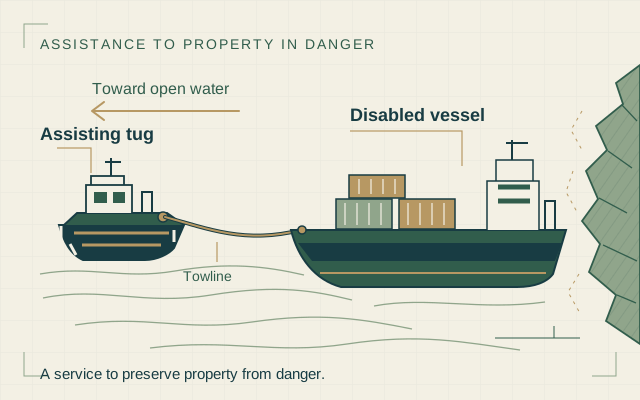
A laden vessel loses power near a dangerous coast. A tug reaches it, establishes a connection and helps bring the ship and cargo to safety. The operation has protected several valuable interests, but the financial questions do not end when the towline is released.
What agreement governed the work? Was this ordinary towage or a salvage service? How is a reward assessed, who bears it, and which insurance might respond? Those questions can produce different answers from the later allocation of repair costs.
Marine salvage concerns assistance to a vessel or other property in danger. An ordinary salvage reward recognises a useful result under the applicable legal and contractual framework. This guide uses the 1989 Salvage Convention, LOF 2024 and SCOPIC 2020 as identified references; their application to a particular casualty must be established.
Salvage is not simply another word for towing
The equipment used does not determine the legal character of the service. A tug can perform routine harbour work, assist under an existing towage contract or undertake a salvage operation when circumstances and obligations justify that treatment.
Existing duties matter. Article 17 of the Convention does not award salvage payment merely for doing what was reasonably required under a contract made before the danger arose. Services exceeding that performance require separate consideration. Equally, a written salvage form is not the only possible basis for a salvage claim: applicable law can recognise services without that form.
The word also appears in cargo claims in another sense. Selling damaged goods for their residual value may be described as a salvage sale. The sale proceeds belong in the loss calculation; they are not a reward to a professional salvor. Our cargo-claim evidence guide keeps those proceeds separate from repair costs and other expenses.
Wreck removal and wider pollution response introduce further liabilities and contracts. A service should be classified from its facts and terms rather than from the general label “recovery operation”.
An ordinary award rewards the result, not just the hours worked
Under the Convention’s ordinary-reward framework, a useful result is important. Assessment considers the property saved, the danger, the degree of success, skill and effort, time and resources, risks undertaken and other prescribed factors. Environmental protection is among the considerations.
That is different from adding up a tug’s day rate. A short, highly skilled intervention in severe danger may have a different reward profile from prolonged work in less difficult conditions. Neither duration nor expenditure alone fixes the amount.
The reward is also not a standard percentage of the ship’s insured value. Salved values and the applicable criteria matter. The Convention limits the ordinary reward by the salved property value, excluding interest and recoverable legal costs from that particular cap. It does not promise that every cost incurred by a salvor will be recovered.
This explains both the incentive and the uncertainty behind the familiar no-cure, no-pay description. The special-compensation arrangements discussed below qualify that description; they do not turn every emergency service into an ordinary property award.
What Lloyd’s Open Form does
Lloyd’s Open Form, or LOF, is a salvage agreement. It is not a hull policy, a P&I entry or an insurer’s acceptance of the casualty. It allows the services and the remuneration framework to be agreed without first negotiating a final monetary reward during the emergency.
LOF 2024 identifies the property and place of safety, provides for best endeavours in saving the property and protecting the environment, and uses English law and London arbitration. The remuneration is then assessed or settled within the agreed framework. The form’s principal no-cure, no-pay approach remains subject to the identified special-compensation provisions.
The contract date and incorporated documents matter. As checked on 2 November 2026, Lloyd’s lists LOF 2024 and the Lloyd’s Salvage Arbitration Clauses 2024 revised in May 2026. That does not rename the agreement “LOF 2026” or change an older contract retrospectively.
LOF also distinguishes whether SCOPIC is incorporated. Including that clause and invoking it are separate events; a tick or deletion recording incorporation does not itself activate its remuneration assessment.
Worked example: allocating an assumed property reward
All events and figures here are invented. Assume the final ordinary property reward has been agreed at £600,000, and the relevant salved values are £9 million for the ship and £3 million for cargo. There are no other interests in this simplified example, and interest, costs and any later recovery disputes are excluded.
| Interest | Assumed salved value | Share of £12 million | Share of reward |
|---|---|---|---|
| Ship | £9,000,000 | 75% | £450,000 |
| Cargo | £3,000,000 | 25% | £150,000 |
| Total | £12,000,000 | 100% | £600,000 |
The £450,000 and £150,000 figures allocate a reward already established. Dividing £600,000 by £12 million happens to give 5%, but that is not a rule for predicting the reward in another casualty. The difficult assessment of the services is an express input, not a conclusion of the arithmetic.
Relevant hull and cargo insurance can address the respective property interests’ liabilities under its terms. P&I involvement in coordinating the incident does not mean the P&I club pays every property reward. See P&I and hull and machinery compared for the different interests those covers address.
Article 14 and SCOPIC address a different payment problem
Saving valuable property may provide a substantial ordinary reward. A difficult operation involving little remaining property value can offer a much weaker financial prospect, even where the work helps avert environmental damage.
Article 14 provides a special-compensation framework where the vessel or cargo threatened the specified environmental damage and the ordinary reward is insufficient against the assessed compensation. The vessel owner owes the qualifying excess. It can apply where some property was saved; it is not confined to a total failure of the operation. Expenses and any environmental uplift have defined conditions.
SCOPIC provides a contractual assessment method as an alternative to Article 14, subject to its terms. Where incorporated, the salvor can invoke it by written notice without having to establish an environmental threat. Assessment runs from invocation, and uses the applicable tariff, expense and bonus provisions. “All actual costs plus 25%” is too loose a description of that scheme.
Article 13 assessment continues. Under the identified SCOPIC terms, the vessel owner’s additional liability is the assessed SCOPIC excess over the total ordinary award, not a second full payment added to that award. If the ordinary award is higher, the clause’s separate discount mechanism can matter instead.
Continue the invented example by assuming £900,000 assessed SCOPIC remuneration and the same £600,000 ordinary award. Assume both are on the required comparable basis, with no currency adjustment, interest or costs. The additional owner liability is £900,000 − £600,000 = £300,000. The combined remuneration is £900,000, not £1.5 million. The property award still has its separate allocation; this top-up is not split 75/25 between ship and cargo.
Gard’s Rule 42 is an identified example of P&I protection for defined Article 14/SCOPIC liabilities. The actual entry, applicable terms and compliance remain necessary; neither invoking the clause nor presenting a calculation is itself confirmation of insurance cover.
Security, general average and the evidence file
A salvor may seek security before releasing the property. Its purpose is to secure the salvage obligation while the amount is determined. This is different from asking an insurer to pay a completed repair invoice.
GA can arise from the same casualty, but GA security does not replace separate salvage security. The two processes concern different obligations and valuation enquiries. Under YAR 2016 Rule VI, separately owed salvage is brought into the GA adjustment only in specified circumstances; it is not automatically redistributed in every case. Article 14 special compensation and the SCOPIC excess are excluded from GA treatment. Our general average guide develops that distinction.
The useful evidence records the danger and changing conditions, who requested and supplied the services, the agreement and notices, equipment and personnel used, decisions made, property saved and place of safety. Operational logs and technical records help explain the result. They also support the later separation of property remuneration, special compensation and other casualty costs.
Start with the obligation before choosing the insurance route
The same response can involve a property reward, special compensation, damaged cargo, repairs and liability enquiries. A coherent account identifies each obligation first, then asks which agreement and insurance terms address it.
That approach avoids a common mistake: treating the entire rescue as one invoice for one insurer. It also explains why a successful operation can leave several financial files open after the ship and goods have reached safety.
Preparing for P&IQ or ICS?
Build on what you have learned with structured P&IQ and ICS study, question practice and mock exams.
Explore exam preparation