
P&I vs hull and machinery insurance: cover and collision claims
Compare H&M and P&I through ship damage, cargo liability, crew claims and a worked collision example, including deductibles and alternative cover arrangements.
On this page
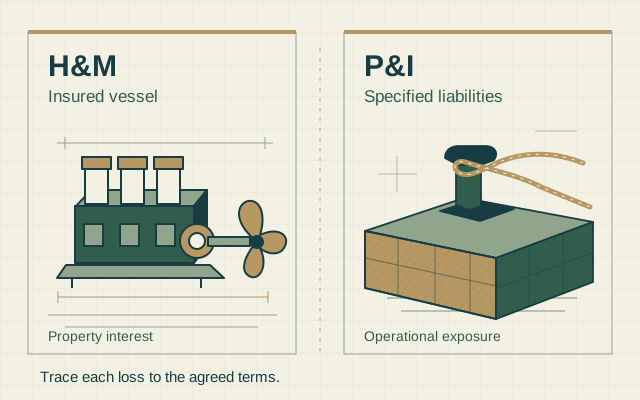
Hull and machinery insurance principally protects the insured ship; P&I addresses specified operational liabilities and related expenses. Collision and contact liabilities can sit in either arrangement, so the hull policy and P&I terms must be read together.
What you will learn
- Separate damage to the insured vessel from liability for damage to someone else.
- Apply an explicitly assumed three-quarter hull and one-quarter P&I collision split.
- Explain why an unpaid hull claim or deductible does not automatically become a P&I claim.
The distinction starts with whose loss it is
After a collision, a shipowner may receive two very different bills: one from the yard repairing its own ship, and another from the owner of the ship it damaged. Both arose from the accident, but one concerns the owner’s property and the other concerns its liability to someone else.
Hull and machinery insurance, usually shortened to H&M, principally protects the insured vessel and its equipment. Protection and indemnity insurance, or P&I, addresses specified liabilities and related expenses arising from the operation. Some liability cover also sits within hull insurance. The contracts determine that boundary.
For an introduction to cargo and earnings cover as well, see marine insurance explained. This comparison concentrates on commercial shipowners’ arrangements; charterers’ cover needs its own attention below.
H&M and P&I compared
| Loss or exposure | Where the insurance enquiry usually begins | The distinction to keep in mind |
|---|---|---|
| Physical damage to the insured vessel | H&M | The owner is claiming for its own insured property |
| Damage to cargo carried aboard | Cargo interest’s cargo insurance; separately, the carrier’s liability and P&I cover | Goods insurance and the carrier’s liability are different claims |
| Crew injury or illness | P&I terms governing the relevant liability or expense | An injury does not require damage to the hull to raise a P&I question |
| Collision damage to another ship | Both H&M collision provisions and P&I entry | The agreed allocation can vary |
| Contact damage to a quay or buoy | H&M contact-liability provisions and P&I terms | A fixed or floating object is a different category from another ship |
| Pollution liability or compulsory wreck removal | Relevant P&I heads of cover | The legal obligation, conditions and exclusions still matter |
| The insured vessel’s lost earnings | Separate loss-of-hire cover, if arranged | A hull repair payment does not itself replace interrupted income |
Gard’s H&M overview and shipowners’ P&I overview illustrate these broad categories. P&I is not a general fund for everything a hull policy leaves unpaid. Its specified heads, entry terms and exclusions still have to be satisfied.
Why collision liability needs both contracts
A collision-liability claim concerns what the assured owes as a result of the collision. It is separate from the assured’s own repair claim. Liability first needs to be established, taking account of fault, the recoverable losses and any applicable legal limitation.
Some arrangements put three quarters of qualifying collision liability under hull insurance and the remaining quarter under P&I. Others provide a different division. Gard Rule 36 expressly allows agreed fractions including one quarter and all four quarters. Neither the product name nor the fact that two vessels collided tells you the split for a particular entry.
There is another easily missed distinction. The other vessel’s recoverable loss of use may form part of the liability claim. The assured’s own lost trading income is a separate first-party earnings exposure, for which loss-of-hire insurance may be relevant.
Worked example: a three-quarter and one-quarter split
The vessel, incident and figures in this example are invented. The Cedar Bay collides with another vessel. For this calculation, assume:
- the owner’s liability to the other vessel has been agreed at £400,000;
- the whole amount falls within the relevant collision cover;
- the hull contract covers three quarters and the P&I entry covers one quarter;
- limits are sufficient, with no applicable deductions, exclusions or other adjustments.
| Agreed allocation | Calculation | Illustrative share |
|---|---|---|
| Hull collision liability | £400,000 × ¾ | £300,000 |
| P&I collision liability | £400,000 × ¼ | £100,000 |
| Total | £300,000 + £100,000 | £400,000 |
This is an allocation of an already established liability to the other ship. It is not a division of fault between the vessels, and it does not allocate the Cedar Bay’s own repair bill. That repair claim would be assessed separately under its hull policy.
The example also does not mean that an actual recovery will be free of deductibles. They have been left out expressly so that the effect of the assumed fractions is visible.
Deductibles and uninsured amounts stay distinct
A deductible is an agreed retention. It does not become payable by P&I just because it leaves part of a hull loss with the owner. Gard Rules 36 and 37 expressly prevent recovery of the hull deductible under those rules.
Specified excess liability can be treated differently. Rule 36 addresses certain liability above the hull sums insured, subject to its conditions. That is a defined extension, not a promise to reimburse every shortfall. A hull claim refused because it falls outside cover, or an amount unpaid because an insurer fails, does not automatically move to the club.
It also helps to separate an insurance limit, which restricts the insurer’s obligation, from a legal liability limit, which may restrict what the assured owes. They operate at different stages of the analysis.
What happens when the ship hits a quay?
Damage to a berth, crane or buoy is commonly discussed as fixed and floating object liability, or FFO. Hull conditions may include contact liability, while P&I may address the relevant liability where it is not hull-covered. Gard Rule 37 is a useful example of that relationship.
The physical-contact requirement matters under that rule. A ship striking a quay and a ship’s wash damaging property without contact are not the same category. Gard’s guidance treats wash damage under a different rule. “Damage at a port” is too broad a description to identify the insurance response.
Cargo insurance and cargo liability follow different routes
Suppose seawater damages a consignment. The insured cargo interest may have a claim under its own goods policy, without first establishing carrier negligence. The carrier, meanwhile, may face a cargo claim governed by its contract and the applicable law. Its responsibility can be affected by defences, causation and legal limits.
After settling a covered cargo loss, an insurer may pursue the cargo interest’s rights against a responsible third party through subrogation. Maersk’s cargo-insurance explanation distinguishes first-party settlement from subsequent insurer recovery. Payment of the insurance claim does not itself establish that the carrier is liable, and the insurer’s recovery remains subject to the rights it takes over.
This is why cargo insurance should not be replaced in the reader’s mind by “the ship has P&I”. The two contracts protect different interests. Who’s who in shipping explains how to identify the carrier and cargo parties.
A charterer’s damaged-hull liability is a different exposure
A charterer can incur liability for damage to a ship it does not own. Cover for that liability is not the same as insuring the vessel as the owner’s property. Gard’s charterers’ P&I product expressly includes charterers’ liability for damage to hull within its specified cover.
The same damaged steel can therefore appear in the owner’s property claim and in an alleged liability claim against a charterer. Their contractual relationships and any rights of recovery must be traced separately; the existence of both covers does not permit double recovery for the same loss.
For a real placement, the useful comparison is between the hull wording, its endorsements, and the P&I rules and individual entry terms. Start with the assured’s capacity and the particular loss. Then consider which contractual promise addresses it, with its own conditions, retentions and limits.
Preparing for P&IQ or ICS?
Build on what you have learned with structured P&IQ and ICS study, question practice and mock exams.
Explore exam preparation