
Who’s who in shipping: owners, charterers and cargo contracts
Understand shipowners, charterers, carriers, shippers and consignees, and how charterparties, bills of lading and sale contracts connect their responsibilities.
On this page
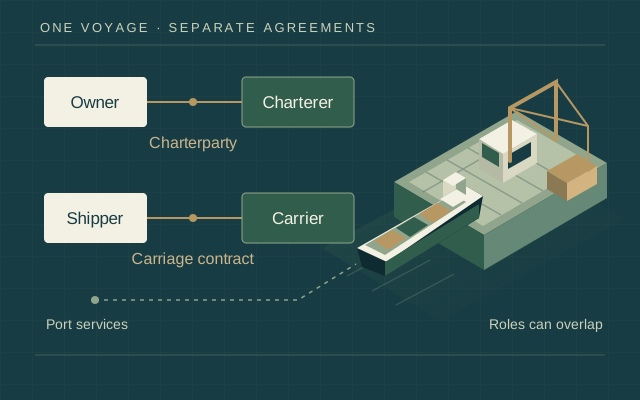
The company that owns a ship is not necessarily the company promising to carry the goods. Ownership, commercial employment, carriage and cargo interests are separate roles, connected by contracts that allocate different responsibilities.
What you will learn
- Distinguish a registered owner, charterer, contractual carrier, shipper and consignee.
- Compare voyage, time and bareboat charter arrangements.
- Connect the sale contract, charterparty and transport document without confusing their functions.
The ship’s name does not identify every party
A cargo receiver reports damaged machinery and sends a claim to “the shipping company”. But which company is that? The registered owner, the business that chartered the ship, and the carrier named in the transport document may be different legal entities.
That distinction matters before anyone considers insurance. The contract under which a company acted helps explain what it promised, which responsibilities it retained and where a claim might belong. One company can hold several roles; a familiar trading name can also conceal several separate companies.
Owner, charterer and carrier: three different roles
The registered owner is the entity registered as owning the ship. A charterer obtains the use of a vessel or its carrying services on agreed terms. A contractual carrier is the party undertaking carriage under the relevant transport contract. These descriptions are related, but they are not interchangeable.
An operator may charter a vessel and then contract to carry customers’ goods. In that transaction it can be both charterer and contractual carrier. A charterer that sub-charters a vessel may act as a disponent owner: it contracts as owner under the sub-charter without being the registered owner. The Baltic Exchange’s chartering guide describes this commercial chain.
The contractual carrier and the party physically performing carriage can also differ. Identify the carrier from the transport contract, the document’s signature and the capacity in which the signatory acted. The ship’s name alone cannot resolve that question.
What changes between voyage, time and bareboat charters?
The charter type changes the allocation of control and expense. The following are typical starting points; negotiated terms can change particular obligations.
| Arrangement | What the charterer obtains | Typical division of responsibility |
|---|---|---|
| Voyage charter | Carriage for an agreed voyage or voyages, in return for freight | Owner supplies the ship and crew and generally bears vessel operating and voyage costs; cargo handling costs depend on the terms |
| Time charter | Commercial use of the ship for an agreed trip or period, in return for hire | Owner retains the ship’s management and crew; charterer directs commercial employment within agreed limits and usually pays bunkers and voyage expenses |
| Bareboat or demise charter | Possession and control of the vessel without the owner’s crew | Charterer takes over crewing and operation and has a much broader operational role |
BIMCO’s GENCON 2022 is an example of a voyage charter form; NYPE 2015 is a dry-cargo time charter form. The form’s name identifies a starting document, not all the terms of a completed fixture. Amendments and additional clauses remain part of the bargain.
Shippers, consignees and cargo interests
The shipper is commonly the party contracting with the carrier and identified as shipper in the transport document. The consignee is the party designated to receive the goods. Maersk’s introductory distinction is useful, but the documents and the capacity in which a party acts still matter.
A seller, shipper and owner of the goods need not be the same person. A forwarding business can arrange transport; a bank may appear in an order bill; and the person receiving the goods may be acting for someone else. Naming a consignee does not, by itself, settle ownership or every requirement for delivery.
For insurance, the next question is who would suffer the financial loss if the goods were damaged at the relevant stage. That is a different enquiry from identifying who booked the vessel or paid the freight.
Sale terms allocate risk without deciding every other issue
Incoterms rules, when incorporated into a sale contract, allocate specified obligations, costs and the point at which risk passes between seller and buyer. They do not themselves determine transfer of ownership or identify the carrier. The ICC’s introduction makes these boundaries explicit.
Insurance obligations also vary. Under Incoterms 2020, CIF and CIP require the seller to arrange cargo insurance, with different default levels of cover. CIF is for sea and inland waterway transport; CIP can be used for any mode or combination of modes. ICC explains that CIF defaults to Institute Cargo Clauses (C) or similar cover, while CIP requires the broader Clauses (A) or similar cover, subject to what the parties agree. It is therefore unsafe to read “seller arranges insurance” as a complete description of the protection purchased.
What a bill of lading does
A bill of lading has three familiar functions: a receipt for goods, evidence of the carriage contract, and, for an appropriate form under the applicable law, a document of title. Britannia’s guide for masters explains why accurate cargo descriptions and signatures matter.
As a receipt, it can record apparent condition; a clean description does not establish the condition of everything concealed inside a package. As evidence of the contract, it can carry terms relied on by a subsequent lawful holder. Where a charterer remains the holder, the charterparty may instead govern the carriage relationship between those parties. The interaction depends on the facts and law.
A negotiable bill and a sea waybill also have different delivery functions. A sea waybill is not a negotiable document of title; delivery normally involves identifying the named consignee rather than presenting an original negotiable bill. Wallenius Wilhelmsen’s delivery guidance illustrates that distinction. Exact release requirements must still be checked for the document in use.
Where brokers, agents and managers fit
A shipbroker helps bring the commercial bargain together, for example negotiating a charter between owner and charterer. A port agent acts for an appointed principal in connection with a port call, arranging agreed services such as clearance, pilots or crew assistance. FONASBA distinguishes these functions and describes the agent’s role as one of representation.
A ship manager provides contracted services, which might include technical management, crewing or commercial management. BIMCO’s SHIPMAN 2024 overview describes the range. Appointing a manager does not, on its own, transfer every obligation imposed on the owner by other contracts or by law.
A freight forwarder arranges transport and related logistics. Its own contract may make it an arranging agent or a contracting carrier. That capacity matters more than the label “forwarder”; BIMCO’s industry overview provides the wider commercial context.
Worked example: one shipment, three contracts
The businesses and events in this example are invented. Alder Engineering sells machinery to Meridian Foods. Coastline Shipping time-charters a vessel from North Quay Shipowning and agrees to carry Alder’s goods. For this example, the bill of lading expressly names Coastline as contractual carrier and is signed on its behalf. Assume Meridian bears the transit risk under the sale terms and has arranged cargo insurance for that interest.
North Quay’s technical manager and the appointed port agent sit alongside these relationships under separate appointments. Neither becomes the carrier merely by handling an operational task.
If the machinery arrives wet, Meridian’s cargo insurance and any claim under the carriage contract are separate routes to investigate. A claim against Coastline must address its obligations and available defences. Any claim against North Quay requires its own legal basis; ownership of the ship is not the whole analysis. Coastline may also have rights or liabilities under its charter with North Quay.
That is why a useful party map starts with the contracts. Once the roles are clear, marine insurance explained shows how the ship, the goods and the parties’ liabilities can be insured separately.
Preparing for P&IQ or ICS?
Build on what you have learned with structured P&IQ and ICS study, question practice and mock exams.
Explore exam preparation