
Cargo insurance: cover, values and goods in transit
Understand whose interest cargo insurance protects, how transit and valuation work, and why a goods claim is different from a claim against the carrier.
On this page
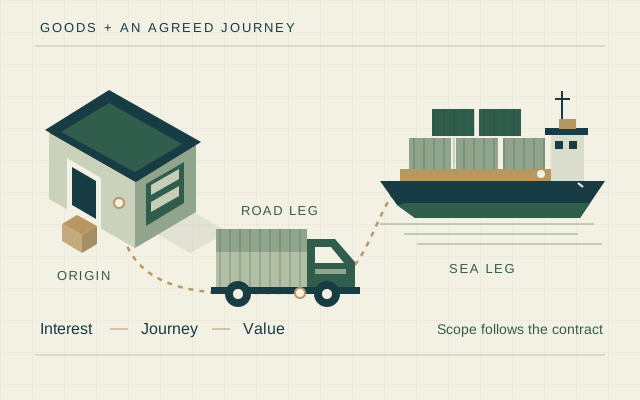
Cargo insurance protects an insured financial interest in goods during an agreed journey. The goods, insured party, value, route and wording must fit together; a carrier’s liability insurance does not provide the cargo owner with the same protection.
What you will learn
- Identify the insured interest, journey and documents behind a cargo placement.
- Distinguish the insured amount from the amount payable for a particular loss.
- Explain how sale terms, transit clauses and recovery rights affect the analysis.
Cargo insurance follows an interest in the goods
A container reaches its destination with a sound exterior, but several machines inside are wet. The buyer wants replacement parts, the seller says risk passed earlier, and the carrier asks for evidence of when the damage occurred. The insurance question begins with those relationships, not with the container alone.
Cargo insurance protects an insured financial interest in goods against agreed risks during the insured transit. The insured interest may belong to a seller, buyer or another party with a relevant financial interest. That interest, and the capacity in which the claimant is insured, must exist when required by the applicable contract and law.
The vessel’s hull insurance concerns a different asset. The carrier’s liability cover concerns a different legal exposure. Our marine insurance overview places these covers alongside one another.
Describe the journey as well as the goods
Marine cargo business can include road, rail and air transport as well as sea carriage. It may also include intermediate storage connected with the journey. The agreed scope should describe the goods and their movement sufficiently clearly to identify where the insurance starts and ends.
For one shipment, that may be a defined factory-to-customer transit. A business with repeated movements may use an annual arrangement covering agreed classes of shipments, subject to its declarations, limits and other terms. The insurance contract determines what must be reported and when; regular trading does not make every movement automatically insured.
A useful description includes the packing, transport legs, transfers and intended storage. “Warehouse to warehouse” is convenient shorthand, but it does not resolve every question about a distribution centre, a change of destination or goods left in a vehicle.
Read the sale and insurance arrangements together
The sale contract helps establish which party bears the transit risk and who must arrange insurance. It is separate from the carriage contract and the insurance contract. Ownership, responsibility for freight and responsibility for loss can change at different points.
Under Incoterms 2020, CIF and CIP require seller-arranged cargo insurance, with different default scope. CIF is a sea and inland-waterway rule using Clauses (C) or similar cover by default; CIP can serve multimodal transport and requires Clauses (A) or similar cover, subject to the permitted agreement between the parties.
The named destination under these terms should not be confused with the earlier point at which risk passes. A seller can arrange carriage and insurance to a destination while the buyer bears the risk during part of that journey. The insurance document must allow the protected interest to use the agreed cover.
For the parties behind these arrangements, see who’s who in shipping.
Insured value and a payable claim are different figures
The insured amount is established on the policy’s agreed valuation basis. The commercial invoice is important evidence, but freight, agreed profit allowances or other components may matter under that basis. A maximum per shipment or location also needs to be distinguished from the annual value of goods moved.
Consider an invented sale with a £50,000 contract price, expressly on CIP Incoterms 2020 terms. On the stated minimum insurance basis, 110% × £50,000 = £55,000. That identifies the required insured amount for this example. It does not establish that £5,000 of physical damage automatically produces a £5,500 payment.
A partial-loss calculation still requires the applicable valuation and settlement terms, the extent of insured damage, any relevant deductions and the evidence supporting the amount claimed. An insurance certificate records cover for the identified interest or shipment; it does not silently expand the underlying wording.
Compare the cause of loss with the scope purchased
Institute Cargo Clauses (A) provide a broad loss-or-damage grant subject to exclusions. Clauses (B) and (C) identify causes of loss, with B covering more listed risks than C. The letters do not describe the quality of the goods, the insurer’s financial strength or an automatic percentage of a claim.
All-risks wording still leaves important boundaries. In the 2009 Clauses (A), examples include ordinary wear or leakage, inherent vice and delay-caused loss, with the stated exception for qualifying clause 2 expenses. The packing exclusion has conditions about who packed and when; it requires more care than the statement that any packing problem defeats a claim.
Specialised goods and operations can require additional terms. Temperature sensitivity, used machinery and project cargo should be described accurately rather than assumed to fit an ordinary label. Our A/B/C comparison works through the wording differences and practical examples.
When does transit cover attach and terminate?
The following is an explanation of the 1 January 2009 Institute Cargo Clauses transit framework, not a universal warehouse rule. Clause 8 connects attachment with the goods’ first movement at the named origin storage place for immediate loading to begin the transit. The insurance then continues through ordinary transit.
Termination follows the earliest applicable contractual trigger. These include completed unloading at final storage, certain elections to use storage outside ordinary transit or for distribution, and the stated deadline after discharge from the overseas vessel. That deadline does not grant an automatic extra period of cover after an earlier termination event.
For example, goods deliberately unloaded into a distribution warehouse may reach a termination point even though many days remain before the overseas-discharge deadline. A changed destination or interrupted carriage can also require attention to clauses 9 and 10 and the agreed notification or continuation arrangements.
Delay creates two separate enquiries: whether the insurance remains in force and whether a loss caused by delay is insured. Continuation during an uncontrolled interruption does not remove a delay exclusion.
Worked example: machinery reaches an intermediate warehouse
The shipment and businesses in this example are invented. A manufacturer sells packing equipment to an overseas buyer. The insurance describes transport from the factory to the buyer’s premises, including an identified intermediate transfer. The equipment is packed in cases and moves by road, sea and road again.
At the intermediate warehouse, the buyer changes its plan. Some cases will now remain there for distribution to several customers. The change should be examined against the actual transit wording and agreed storage scope. The phrase “warehouse to warehouse” cannot establish that the new arrangement remains covered.
Later, one case is found damaged. The investigation needs its movement history, condition at each handover and evidence of the cause. If the damage occurred after transit cover had terminated, a sufficient insured value and broad risk wording would not cure the duration problem. If the relevant loss occurred during the insured journey, the cause and exclusions would still need examination.
The example shows why scope, value and duration belong in the same insurance description.
A goods claim and a recovery against the carrier
For a qualifying first-party cargo loss, settlement need not depend on proving carrier negligence first. The claimant still needs evidence of its insured interest and a covered loss. Separately, it may have rights against a carrier, warehouse or another responsible party.
Those rights need protection while the insurance claim is investigated. Notice, evidence and time limits under the transport arrangements are separate from reporting the loss to the insurer. An insurer that pays may exercise the relevant rights through subrogation, subject to the rights and defences it takes over.
Keep delivery records, packing and condition evidence, the relevant contracts and a clear loss calculation. Cargo claims and evidence explains how these documents fit together and why an invoice total alone is not a complete claim.
Preparing for P&IQ or ICS?
Build on what you have learned with structured P&IQ and ICS study, question practice and mock exams.
Explore exam preparation