
Preparing a marine insurance submission: what underwriters need
Build a useful marine insurance submission with the right vessel, cargo, liability and claims information, clear assumptions and a practical renewal example.
On this page
A good submission explains the operation, the insurance requested and the evidence behind the risk assessment. The underwriter should be able to distinguish established facts, estimates and unresolved questions without reconstructing the business from attachments.
What you will learn
- Assemble the information needed for a vessel, cargo or liability submission.
- Connect surveys, claims records and operating procedures with the risks they describe.
- Keep the request for terms, outstanding information and agreed cover distinct.
Start with a description of the business
A renewal email arrives with a vessel spreadsheet, a claims printout and last year’s policy. Each attachment may be useful, yet none explains that the owner is about to change the vessels’ employment. The most important underwriting fact can be missing from an otherwise substantial file.
A submission is the presentation of a proposed insurance risk to an insurer, often through a broker. Its first job is to explain what the applicant does and what it wants insured. A concise account of the operation should make the supporting documents easier to read.
For the decision behind the information request, start with how marine underwriting works. This guide concentrates on preparing the material that supports that decision.
Define the applicant, capacity and request
Identify the legal entities and the capacity in which each needs protection. A registered owner, technical manager, charterer and cargo seller can face different exposures. A company appearing on a group organisation chart does not automatically acquire the same insured status as every other group company.
The opening summary should state the class of insurance, the proposed period or transit, the operations and territories involved, and the requested values or limits. It should also explain whether the enquiry is a renewal on existing terms, a change in cover or a new placement.
Separate the current position from the proposed one. “The fleet has three vessels” is ambiguous if one is being sold and another is joining halfway through the period. Dates, vessel identities and ownership or charter arrangements resolve that ambiguity more effectively than a longer general description.
Match the supporting information to the class
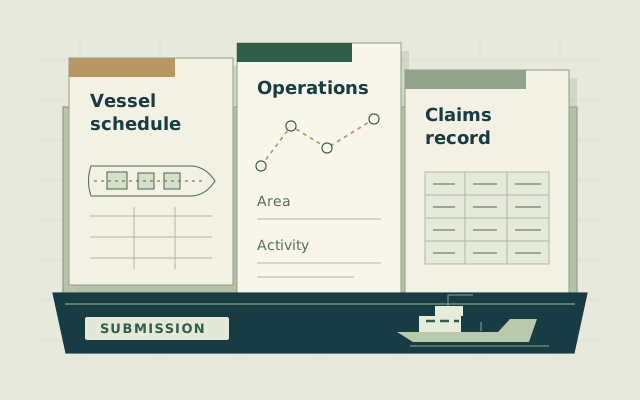
There is no single form that adequately describes every marine business. Skuld’s published entry-form categories distinguish owners from charterers and other operations. RLI’s commercial hull and P&I quotation requirements provide another example: application information, a vessel schedule, surveys and an account record each serve a different purpose.
| Submission | Information to bring together | What the underwriter is trying to understand |
|---|---|---|
| Hull and machinery | Identified vessels, values, construction and machinery details, condition and survey records, management and employment | The property exposed, how it is operated and the potential for damage or costly repairs |
| Cargo | Goods, packing, transport chain, handling, storage, annual movements and maximum values | Damage mechanisms, duration of exposure and concentrations at a vessel or location |
| P&I or charterers’ liability | Insured capacity, vessel employment, cargoes, people exposures and relevant contractual commitments | The liabilities arising from the applicant’s actual role |
Use schedules consistently. A ship name can change; a reliable identifier helps connect the vessel schedule with its survey and loss history. For cargo, distinguish annual turnover from the maximum amount travelling together. Neither figure substitutes for the other.
The GDV cargo risk framework also draws attention to the transport provider, route, packing and storage. A statement that goods travel “in containers” leaves the condition of the goods and the method of securing them largely unexplained.
Supply evidence of controls and outstanding work
A survey reports what was inspected, when and within its stated scope. The age of a report and the status of its recommendations matter. A report identifying a defect, an owner’s plan to repair it and evidence that the repair was completed are three different records.
The same principle applies to operating procedures. An instruction to test hatch covers is more informative when accompanied by the testing arrangements and relevant results. A cargo packing specification is stronger when it identifies the goods, the protective method and who checks compliance.
An underwriter may seek further technical inspection, operational assessment or specialist advice. Those enquiries can be part of understanding the risk; they should not be mistaken for a guarantee of insurability. Skuld’s published survey and loss-prevention work illustrates the connection between information, operations and continuing risk assessment.
Present the claims record with its basis intact
A claims total needs a valuation date, a period and a definition. Explain whether the figures include payments, outstanding estimates, fees and recoveries, and whether they are before or after the assured’s deductible. Identify open claims and material developments since the report was prepared.
Attach a short explanation of significant incidents and completed corrective action. “No recurrence” means little without knowing the number of voyages or operations since the incident. An unresolved cause should remain unresolved in the presentation rather than being replaced by a convenient explanation.
Our guide to marine loss records works through paid and outstanding amounts and shows why two apparently similar accounts can tell different stories.
Make information gaps visible
A useful submission distinguishes a measured value, a management estimate and information still being obtained. It should also identify assumptions that would change the cover requested. Labelling a storage value as provisional is more honest and useful than presenting an unsupported figure as settled fact.
Where the UK’s Insurance Act 2015 applies to non-consumer insurance, fair presentation involves material information and a clear, accessible presentation of the risk. It is wider than completing a form. The Act addresses the insured’s knowledge, reasonable searches and circumstances that put an insurer on notice to enquire further. The applicable law and contractual arrangements must be considered; this is not an international rule that every application follows identically.
For practical file management, keep one dated submission summary and a list of later additions. Correct an error expressly. A revised attachment sent without explaining the change can leave different participants relying on different information.
Worked example: a workboat renewal with a change of use
The companies and events in this example are invented. Seabrook Marine owns two workboats and requests renewal of hull and P&I cover. The vessel schedule is unchanged. A discussion with the operations manager reveals that one workboat will move from harbour support to a different offshore contract during the next period.
The useful response is to describe the new work, its location, the vessel’s duties, people carried and relevant contractual obligations. The existing cover and the new contract then need to be compared. A familiar vessel does not make an unfamiliar operation a routine renewal.
The broker obtains the proposed contract, updated operating details and evidence about the vessel’s suitability. A survey recommendation is still open, so its status and intended completion date are stated. The underwriter can now consider the change with the relevant facts visible, rather than infer it from a vessel name.
The outcome might be a request for further evidence, different proposed terms or a refusal of the new activity. The example establishes no premium or acceptance. Its lesson is that a submission must describe the coming operation as well as the historical one.
Close the gap between proposed and agreed terms
Before cover is treated as arranged, the parties need to know which terms have been accepted, the insurer’s participation, the effective date and time, and the treatment of outstanding conditions. A quotation, a request for additional information and an agreement to insure have different functions.
Contract certainty in the UK/London-market framework concerns agreement of the terms when the contract is entered into, with documentation following promptly. It does not mean that an unsigned draft schedule or a friendly exchange of emails can be assumed to settle every material point.
A practical handover record brings together the accepted wording, insured entities and capacities, values or limits, retentions, conditions and relevant instructions. Later changes should be recorded against that agreed position. The submission then remains useful to the assured and the claims team as well as to the underwriter who first read it.
Preparing for P&IQ or ICS?
Build on what you have learned with structured P&IQ and ICS study, question practice and mock exams.
Explore exam preparation